A shipbuilding and repair port is defined by the quality of its infrastructure, the relevance of its development choices, the expertise of its teams and the richness of its industrial fabric. These elements form a comprehensive environment, where each component contributes to the success of a technical stopover, a maintenance operation or the construction of a ship.
Unrivalled capacity for shipbuilding and repair
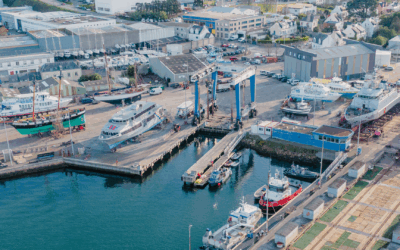
Historically focused on welcoming fishing and cargo ships, the Port of Concarneau – CRN now has a range of complementary infrastructure that gives it a particularly large capacity.
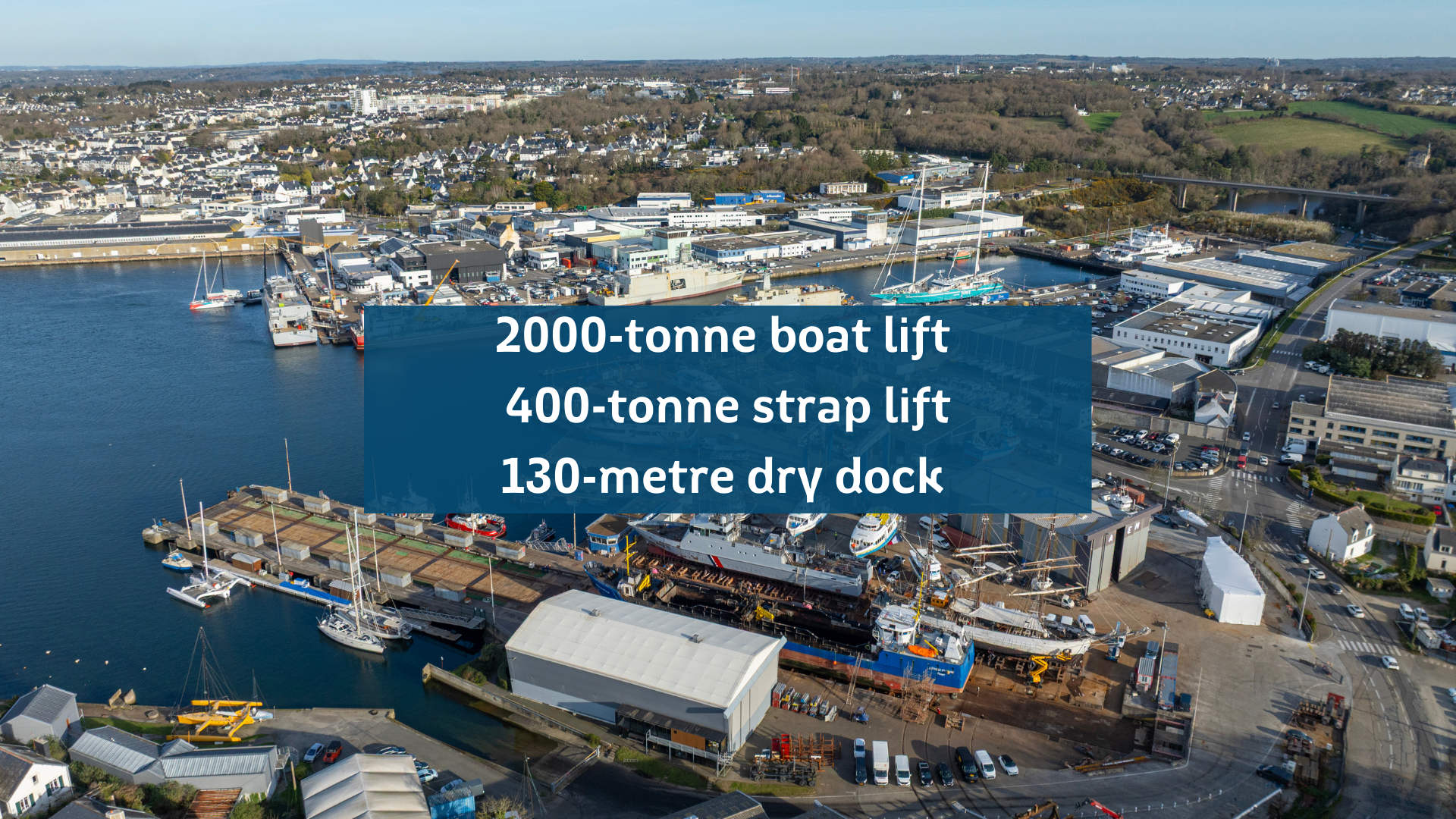
Before the 2000s, the site was already bustling with activity, with more than 300 ships per year at the slipway and around 40 ships per year at the lift. The creation of the dry dock in 2002 marked a turning point. Very quickly in demand, it now welcomes up to twenty ships a year, attracted by its modern facilities, including an access ramp that facilitates operations.
In 2018, the slipway was replaced by a 400-tonne strap lift, enhancing the port’s versatility and responsiveness.
These facilities are supported by a water area offering a depth of 6 metres below chart datum, a major advantage for manoeuvring and accommodating vessels of various sizes and types.
Although in high demand, the dry dock nevertheless offers real operational flexibility, with slots available for both short-term emergencies and scheduled technical shutdowns. The size limits – up to 115 metres in length and 18 metres in width – are assessed on a case-by-case basis, depending on the manoeuvrability of the vessel, under the authority of the Harbour Master’s Office.
Historic ships: sand barges (e.g. Côtes de Bretagne, St Pierre), passenger boats (e.g. Gironde, Bac de l’Estuaire), government service vessels (e.g. MCMV, Patrouilleur Océanique), tugboats (e.g. Abeille Bourbon), supply vessels (e.g. Bourbon Astyanax), tankers (e.g. Cap Mejean), maritime works vessels (e.g. Wind Of Pride, VOE Earl, Cable Vigilance), research vessels (e.g. Atalante, Plastic Odyssey), yachts (e.g. Yersin, Maricha III), sailing ships (e.g. Belem), others (e.g. Race For Water trimaran) …
The new hold door, combined with an experienced team, enables particularly short turnaround times, both in terms of preparing the hull and between the ship’s arrival and the start of dry dock work.
The boat lift, currently operating at 44% of its capacity, is a strategic piece of equipment between the dry dock and the belt elevator. It provides continuous support for the hull along the entire length of the keel, which is a decisive advantage for ‘flexible’ hulls such as old rigs. Its 17.5-metre-wide dock and 2,000-tonne lifting capacity enable it to accommodate a wide variety of vessels.
Historic ships: fishing boats (e.g. Danny Finn), sailing transport ships (e.g. TOWT), maritime works (e.g. TSM Ouessant, Milouin), maritime transport (e.g. Vaitere), tugboats (e.g. Typhon), customs patrol boats (e.g. Kermorvan), old sailing ships (e.g. Français, Stad Amsterdam, Hermione), passenger boats (e.g. Bangor, Enez Eussa, Vindilis), barges or pontoons (e.g. Le Ter), tankers (e.g. Florence B), dry dock carriers (e.g. Forme 3 de Lorient), yachts (e.g. Ice Angel), catamarans (less than 17.5m wide), etc.
The 400-tonne strap lift, used at 53% of its capacity, stands out for its versatility in terms of load distribution. Its 12-metre-wide dock and 3.5-metre keel pit can accommodate fishing vessels, transport vessels, public service vessels, professional pleasure craft, classic sailing boats, multihulls, IMOCA masted boats and even sailing transport vessels.
Historic vessels: fishing boats (e.g. P’tit Emile), maritime transport vessels (e.g. Molenez), SNSM lifeboats (e.g. Plac’h-Dolan), CTVs (e.g. HST Pool), French Navy training ships (e.g. La Ménagerie), passenger boats (e.g. Nevez Amzer), gendarmerie launches (e.g. Elorn), old rigs (Corentin, Marche Avec, Jane), classics (e.g. Skeaf, Moonbeam IV, Mariquita), catamarans (less than 12m wide, e.g. WeExplore, Nautitec 40), IMOCA boats (e.g. Apivia, V&B, Holcim PRB), exploration sailing ships (Fleur Australe), sailing transport (Persévérance, Grain de Sail II), dry dock gates (e.g. Porte de la forme 3 in Lorient), heavy pontoons (e.g. Loctudy pontoon), yachts (e.g. SY Path, Mamma’s), etc.
Finally, the Roudouic slipway, operated by dry docks, completes the facilities for pleasure boats and fishing vessels up to 15 metres, 20 tonnes and 2.1 metres draught. Beyond these specifications, the infrastructure at the Port de Concarneau CRN operates in a complementary manner, ensuring a solution tailored to each vessel.
A port designed in collaboration with shipowners, shipyards and naval service providers
The infrastructure at the Port of Concarneau – CRN is the result of long-term consultation with those who use it. Shipowners, shipyards and technical service providers have, over time, contributed to the design, sizing and development of the facilities, in direct response to operational realities.
The Port thus reflects its economy and its uses. This ongoing consultation explains the consistency of its developments and their suitability to the needs of the sector.
Even today, the port’s stakeholders are actively involved in its development, with a view to continuous improvement.
The CCI has played a key role in the development of the site, listening to users and professionals. This dynamic is now entering a new phase, with the commitment of the Region, which, under the DSP contract, supports the port and finances the majority of investments.
As successive shareholders in the operating company – SEMCAR in the past, CARENCO today – local economic stakeholders support the port in both its day-to-day management and its structural investments, while sharing their expertise in governance.
CARENCO’s port operations are run by a close-knit team of nine people, supported by a unique network of expertise. The infrastructure is operated by a company that is independent of the shipyards, guaranteeing each shipowner complete freedom of choice. Whether work is carried out in-house, outsourced to external companies or delegated entirely, each shipowner is free to define their own level of service.
A cradle of naval skills and supplies
The Port of Concarneau, Shipbuilding and Repair, benefits from a particularly dense maritime environment. This concentration offers great responsiveness and a wide range of skills. When needs arise, companies located near Concarneau are accustomed to working in the port, ensuring perfect operational continuity.
This wealth of resources makes it possible to absorb large volumes of activity while maintaining a high level of service quality. Several programmes can thus be carried out simultaneously: fleet maintenance (such as the Ménagerie), complex technical shutdowns, new construction or conversions, without slowing down operations, even during periods of high activity.
This dynamic is based in particular on a strong collective structure, supported by three professional associations:
- the Interprofession du Port de Concarneau (IPC),
- the Groupement des Professionnels du Nautisme de Concarneau (GPNC),
- the Association des Métiers de la Plaisance de Concarneau (AMPC).
They promote coordination, exchanges and representation among stakeholders, contributing to the overall performance of the site.
Designed by and for maritime professionals, the Port of Concarneau, Shipbuilding and Repair, a port in the Brittany region, is committed to operational efficiency. Here, hospitality is not a two-way street: the CARENCO team, which operates the port, adapts to the needs of shipowners, regardless of their flag, activity or mode of operation.
Once a major fishing port, Concarneau is now a leading centre for shipbuilding and repair, buoyed by a strong industrial history and expertise passed down through several generations. Here, the sea shapes careers as much as it shapes the region itself.
More than just a port facility, the Port of Concarneau CRN is a living ecosystem, attractive to shipowners and professionals, where skills and capacity come together naturally. A shipbuilding and repair port is not something that can be decreed; it is built through use, experience and trust, the fruits of today’s and tomorrow’